

 Home
HomeWhich Countries Issue the Most Interpol Red Notices? 2026 Ranking

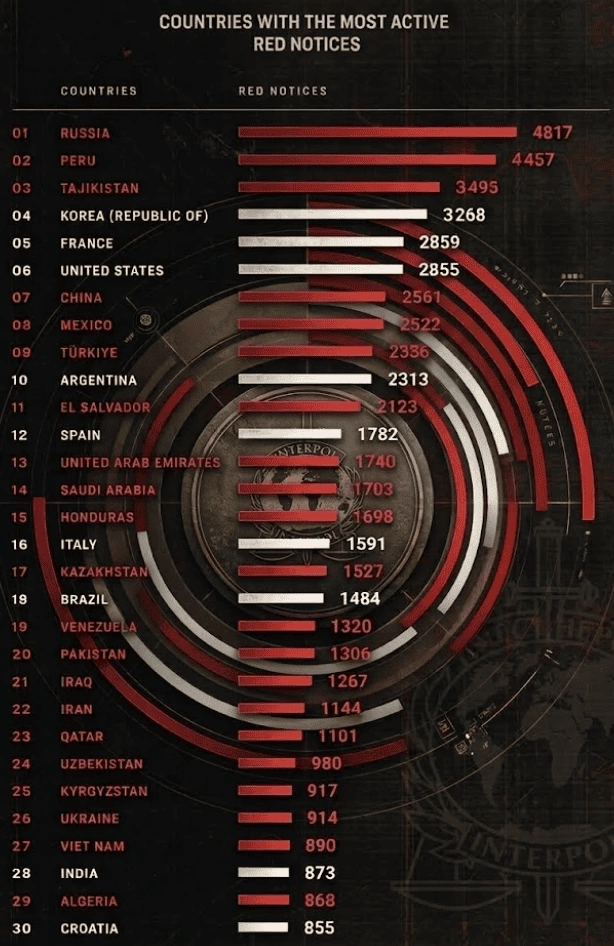
Is there an official league table for countries using INTERPOL’s powerful alert system? Many assume so, but the reality is more complex. INTERPOL itself doesn’t publish a country-by-country ranking of who requests the most Red Notices. Still, based on data from non-governmental organizations and parliamentary inquiries, a clear pattern emerges. Countries like Russia, Peru, and Tajikistan are consistently flagged as some of the most prolific requesters of these international alerts.
Red Notice – An international alert issued by INTERPOL at the request of a member country to seek the location and provisional arrest of a person wanted for prosecution or to serve a sentence. It is based on a valid national arrest warrant but is not an international arrest warrant itself; each member country decides what legal action to take in response.
What Is the 2026 Ranking for Countries Issuing the Most INTERPOL Red Notices?
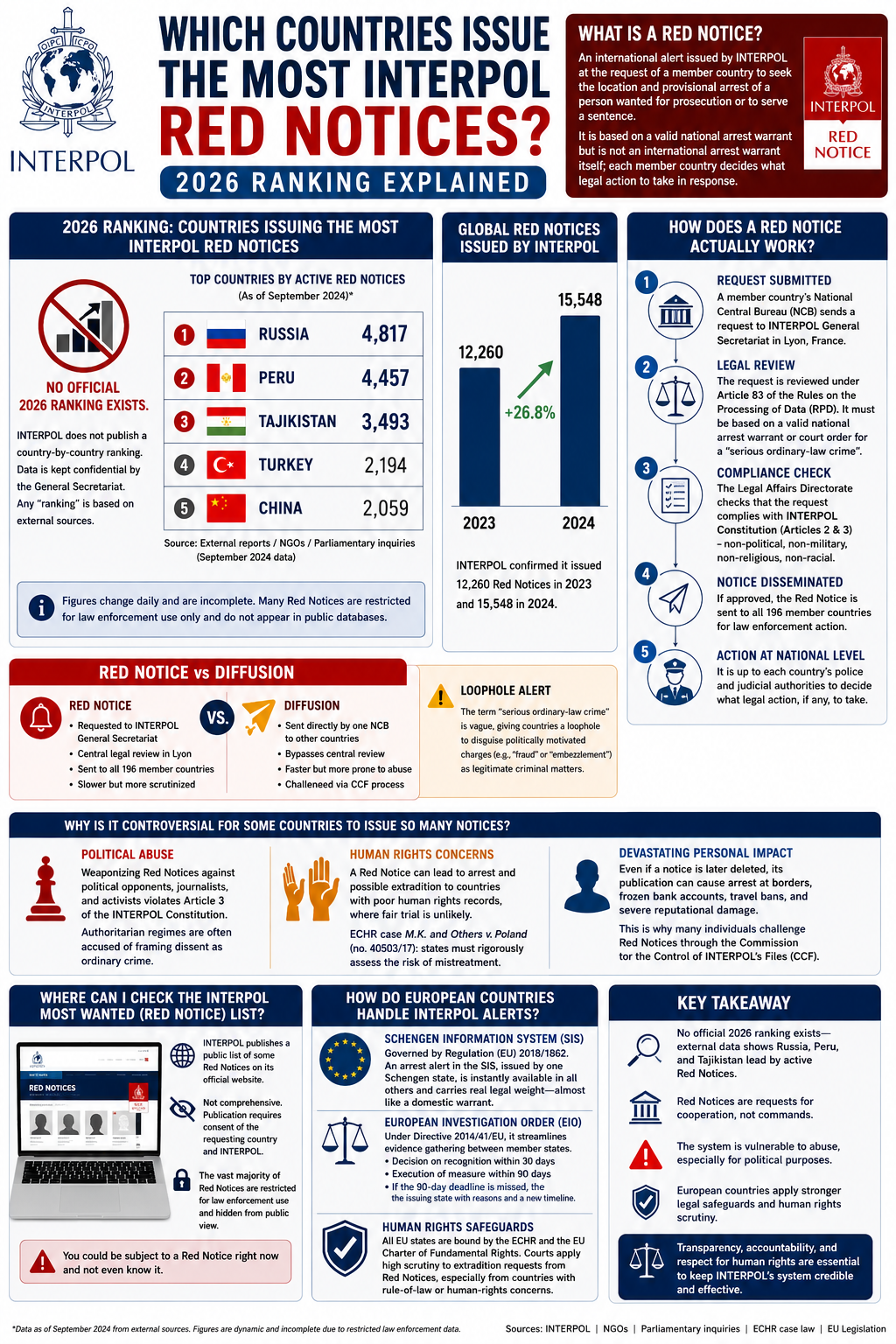
The short answer: no official 2026 ranking exists. INTERPOL’s General Secretariat keeps the data on which member states request the most notices confidential. This lack of transparency means any “ranking” you see is actually an analysis from external sources like leaked data, investigative journalists, or human rights groups.
These outside sources consistently point to the same handful of countries. One widely cited report, using data from September 2024, showed Russia with 4,817 active Red Notices, Peru with 4,457, and Tajikistan with 3,493. These numbers change daily, of course, but they reveal a trend. Certain nations rely heavily on the system. It’s a different issue from the system’s overall growth; INTERPOL confirmed it issued 12,260 Red Notices in 2023, and that number swelled to 15,548 in 2024. You can find more detail by examining INTERPOL Red Notice statistics.
The problem is that these figures are always incomplete. Why? Many Red Notices are restricted for law enforcement use only, so they never appear in public databases. A complete picture is elusive.
How Does a Red Notice Actually Work?
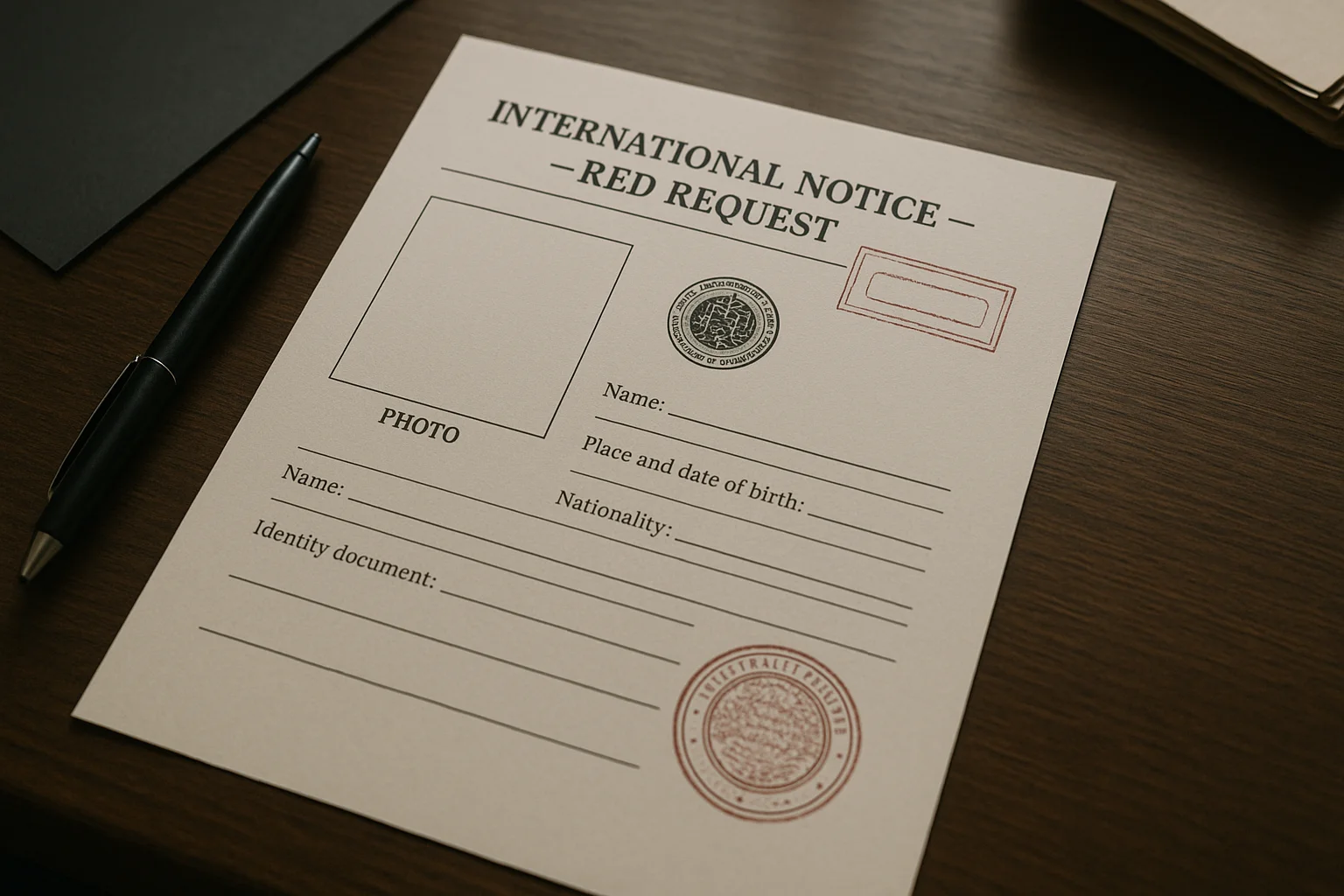
A Red Notice is a request for cooperation. Not a command. Its legal authority comes from INTERPOL’s own constitution, especially Article 2 and Article 3, which strictly prohibit the organization from undertaking activities of a political, military, religious, or racial character.
The process kicks off when a member country’s National Central Bureau (NCB) sends a request to INTERPOL’s General Secretariat in Lyon, France. Under Article 83 of INTERPOL’s Rules on the Processing of Data (RPD), this request must be tied to a valid national arrest warrant or a court order for a “serious ordinary-law crime.” The General Secretariat’s legal team then reviews it for compliance. The issue is that “serious ordinary-law crime” is vague, giving countries a loophole to disguise politically motivated charges (like “fraud” or “embezzlement”) as legitimate criminal matters.
If the request gets the green light, the Red Notice is sent to all 196 member countries. It is then up to the police in each country to decide what action, if any, to take.
Why Is It Controversial for Some Countries to Issue So Many Notices?
The controversy around high-volume issuers comes down to one thing: abuse. The system is too often used for purposes that fly in the face of INTERPOL’s own charter. The main concerns are:
- Political Abuse: Weaponizing Red Notices against political opponents, journalists, and activists is the biggest problem. This is a direct violation of Article 3 of the INTERPOL Constitution. Authoritarian regimes are frequently accused of framing legitimate political dissent as an ordinary crime to trigger an international alert.
- Human Rights Concerns: A Red Notice can lead to an arrest and potential extradition to a country with a dismal human rights record, where a fair trial is a fantasy. European courts have become particularly vigilant. In the case of M.K. and Others v. Poland (no. 40503/17), the European Court of Human Rights (ECHR) emphasized that states must rigorously examine the risk of mistreatment before surrendering anyone based on an international alert.
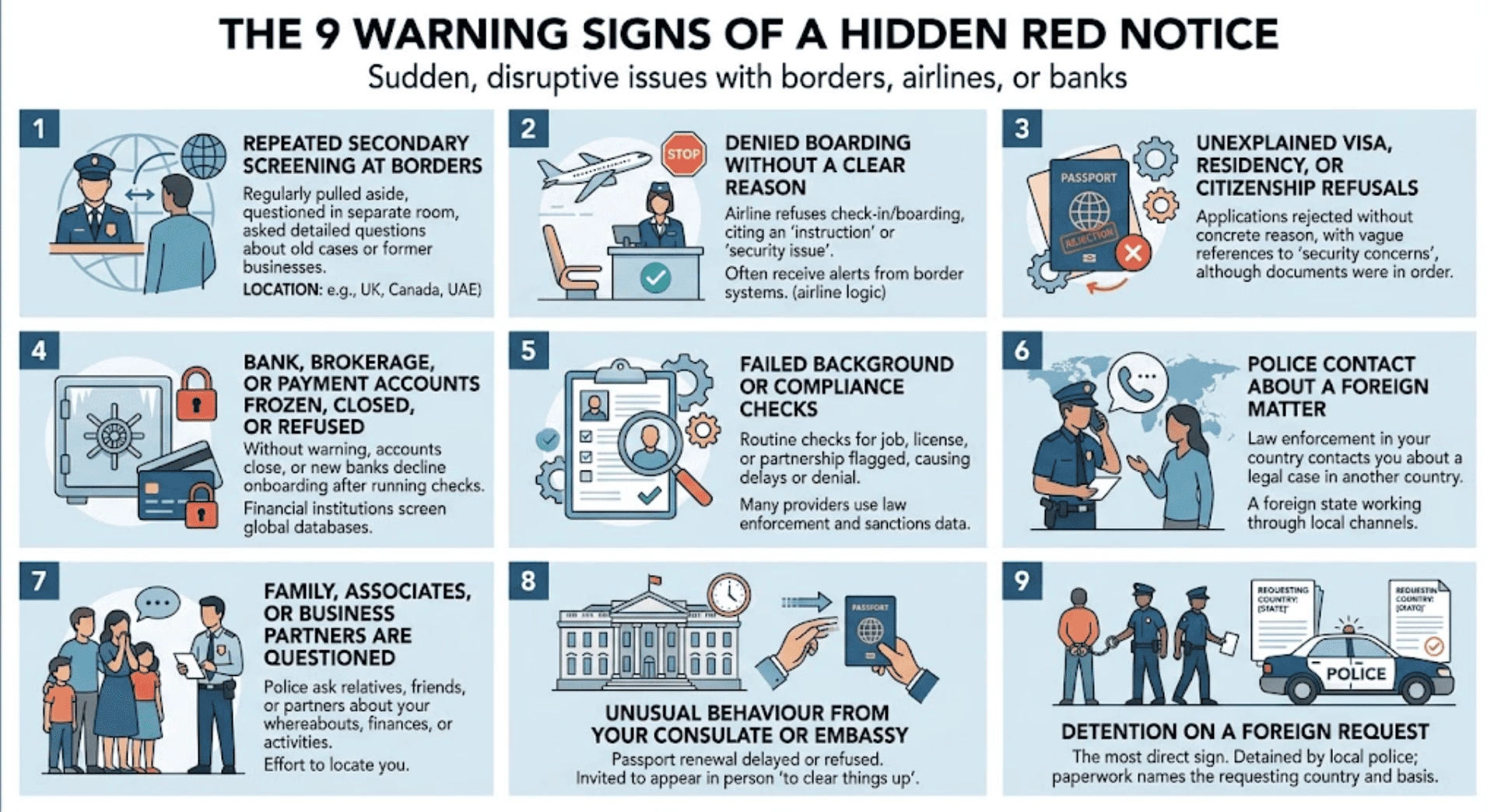
- Devastating Personal Impact: Even if a Red Notice is eventually deleted, its initial publication can shatter a person’s life. It can lead to arrest at a border, frozen bank accounts, an inability to travel, and immense reputational damage. This is why so many people proactively challenge an Interpol Red Notice through the CCF.
Where can I check the INTERPOL Red Notice most wanted list?
INTERPOL does maintain a public list of some Red Notices on its official website. This is what people usually mean by the “INTERPOL wanted list 2026” or “INTERPOL top 10 most wanted.” But it is not comprehensive. For a notice to be public, the requesting country must agree and INTERPOL must decide that publicizing it is safe and will help find the person. The vast majority of Red Notices are restricted for law enforcement use and are hidden from public view. This means you could be subject to a Red Notice right now and not even know it.
How Do European Countries Handle INTERPOL Alerts?
European Union member states have a more integrated and scrutinized system for cross-border alerts, which often creates friction with Red Notices from non-EU countries.
Inside the EU, the main tool is the Schengen Information System (SIS), governed by Regulation (EU) 2018/1862. An arrest alert in the SIS, issued by one Schengen state, is instantly available and carries real legal weight in all others, functioning almost like a domestic warrant. It is a much sharper tool than a Red Notice.
When it comes to gathering evidence, the European Investigation Order (EIO), under Directive 2014/41/EU, creates a streamlined process. It forces member states to act on evidence requests within set timeframes, requiring a decision on recognition within 30 days and execution of the measure within 90 days. If a country misses the 90-day execution deadline, it must immediately inform the issuing state, explaining the delay and estimating a new timeline—this accountability is a key feature.
Critically, all EU countries are bound by the European Convention on Human Rights and the EU Charter of Fundamental Rights. This forces their national courts to apply a high level of scrutiny to any extradition request that comes from a Red Notice, especially from countries with known rule-of-law or human-rights problems. UK courts, for example, have deeply examined the human rights implications of INTERPOL-related actions in cases like Muthana v. Secretary of State for the Home Department [2017] EWHC 2970.
⚠️ Time is critical — every day matters
Get a free case assessment
Our team specialises in cases with an international element. We review applicable treaties, assess risks, and prepare an action plan.
🔒 Confidential · Response within 24h · No obligation
Frequently Asked Questions
What is INTERPOL Red Notice most wanted list?
The “most wanted list” is simply the public part of INTERPOL’s Red Notice database. It is not the full list. For a fugitive’s name to appear there, the requesting country must ask for it to be made public. Its main purpose is to ask the public for help in locating someone. Most Red Notices are restricted for law enforcement eyes only.
What is Red Notice INTERPOL?
A Red Notice is an international alert requested by an INTERPOL member country to find and provisionally arrest a wanted person. It must be based on a valid national arrest warrant or court order. The key thing to remember is that it is not an international arrest warrant. INTERPOL has no power to force any country to arrest the person named in the notice.
What Is the 2026 Ranking for Countries Issuing the Most INTERPOL Red Notices?
The short answer: no official 2026 ranking exists. INTERPOL’s General Secretariat keeps the data on which member states request the most notices confidential. This lack of transparency means any “ranking” you see is actually an analysis from external sources like leaked data, investigative journalists, or human rights groups.
How Does a Red Notice Actually Work?
A Red Notice is a request for cooperation. Not a command. Its legal authority comes from INTERPOL’s own constitution, especially Article 2 and Article 3, which strictly prohibit the organization from undertaking activities of a political, military, religious, or racial character.
Why Is It Controversial for Some Countries to Issue So Many Notices?
The controversy around high-volume issuers comes down to one thing: abuse. The system is too often used for purposes that fly in the face of INTERPOL’s own charter. The main concerns are: