

 Home
HomeCan an Old Foreign Case Come Back Years Later with an Interpol Red Notice?

Yes. An old case abroad can resurface years, or even decades, later, and it often does so as an Red Notice. But this power isn’t limitless. The notice’s validity depends on the laws of the country that wants you, on international treaties, and on Interpol’s own rules, especially the statute of limitations. It all comes down to one question: is the original national arrest warrant still legally enforceable?
For people who live in or travel through the UAE, the question is far from theoretical. Dubai is a major international hub, and a Red Notice issued years after a dispute that you thought was closed can surface at passport control, during a residence renewal, or in a bank compliance check.
Why Do Old Cases Abroad Resurface Years Later?
A case that has been quiet for years rarely comes back by accident. Typical triggers include:
- A new complaint on old facts. A former partner, creditor, or employer files or revives a criminal complaint once a civil or commercial dispute has failed.
- Asset tracing. Authorities or claimants locate your assets or business abroad and use a Red Notice to put pressure on you.
- A change of government or priorities. A case that was dormant becomes politically or institutionally convenient again.
- Judgment in absentia. You were tried or sentenced without knowing it, and the sentence is now sent for international enforcement.
- Testimony of co-defendants. Someone else in the same case names you and the file is reopened.
- Better data sharing. Digitized archives and cross-border databases make old warrants easier to find and to circulate.
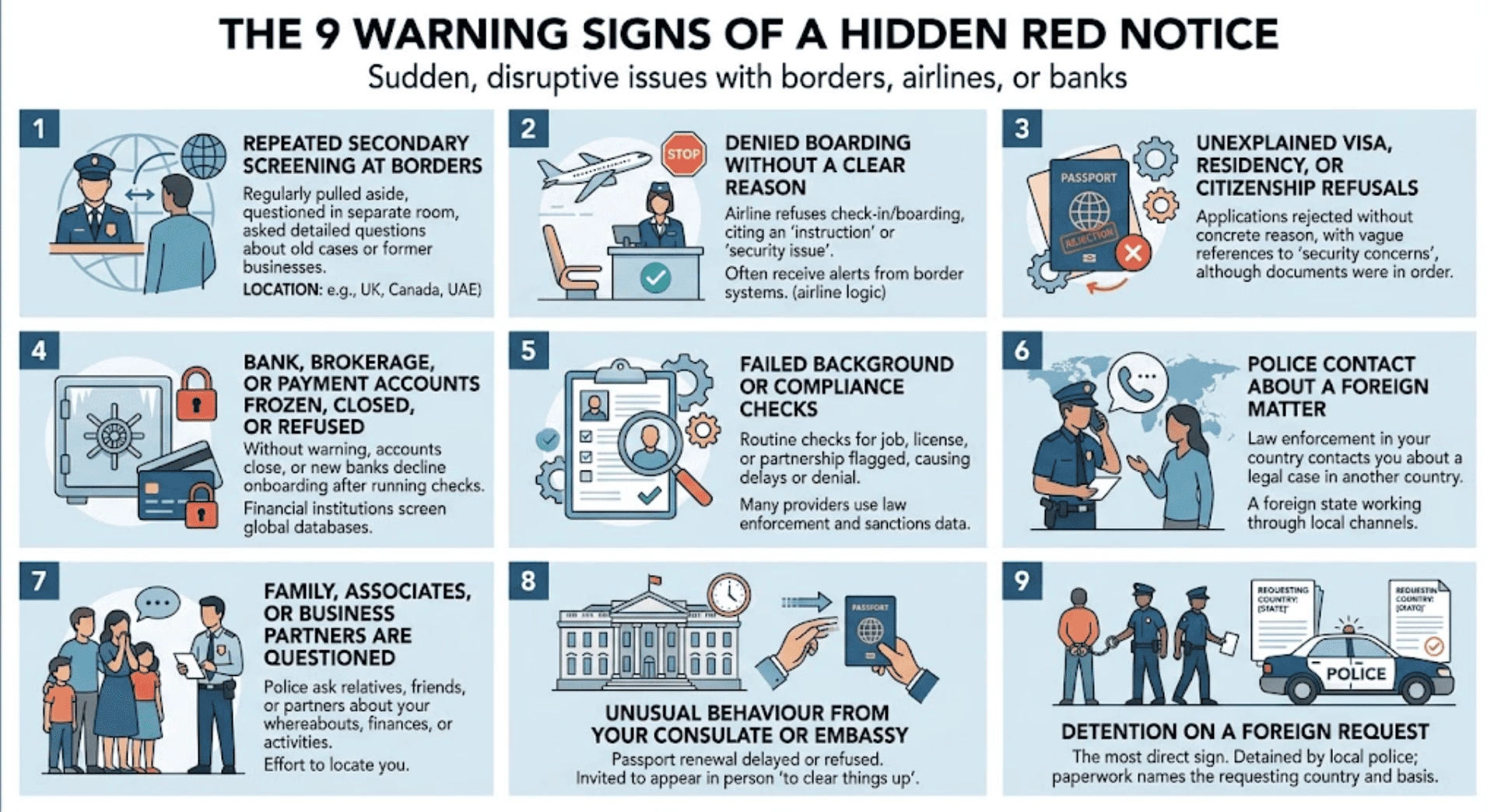
In many of these situations the person learns about the case only when something goes wrong: a denied boarding, a long secondary inspection, or a frozen account. If this sounds familiar, read our guide on signs that you may have an Interpol Red Notice.
What Exactly Is an Interpol Red Notice (and What Isn’t It)?
An Interpol Red Notice is an international alert. It is not an international arrest warrant. Under Article 82 of Interpol’s Rules on the Processing of Data (RPD), its purpose is to seek the location and provisional arrest of a person pending extradition, surrender, or similar legal action. Each member country then decides what legal weight to give a Red Notice within its own borders.
The notice is issued by the Interpol General Secretariat, but only at the request of a member country’s National Central Bureau (NCB). It must be based on a valid national arrest warrant or judicial decision. This means the problem starts in one country, which then uses Interpol’s network of 196 members to broadcast its alert.
Crucially, a Red Notice must comply with Interpol’s Constitution. Article 3 strictly forbids the organization from undertaking any intervention or activities of a political, military, religious, or racial character. This provides a key defense against notices that are politically motivated but presented as ordinary criminal matters.
How is a Red Notice different from a Blue Notice?
A Red Notice and a Blue Notice serve completely different functions. A Red Notice is a request to locate and provisionally arrest a person for potential extradition. Think of it as a “wanted” poster. In contrast, a Blue Notice is an inquiry tool. It’s used to collect more information about a person’s identity, location, or activities for an ongoing investigation and does not call for an arrest.
Are individuals on this list wanted by Interpol itself?
No. Interpol is an inter-governmental organization that helps police forces cooperate; it has no police, no investigators, and no power to arrest anyone. The people named in Red Notices are wanted by the requesting member country, not by Interpol. Interpol is simply the secure information channel.
How Do Time Limits and Statutes of Limitation Affect a Red Notice?
A Red Notice has no universal expiration date. Its legitimacy is tied to the underlying national arrest warrant. If the offense can no longer be prosecuted in the requesting country, for example because the statute of limitations has run out, the legal basis for the Red Notice weakens and you may have strong grounds to demand its deletion.
Be careful with this argument, though. Two different limitation periods are often confused:
- Limitation of prosecution: the period during which a person can still be charged or tried for the offense.
- Limitation of enforcement: the period during which an already imposed sentence can still be carried out.
In many countries these periods are suspended or interrupted while a person is a fugitive, is outside the country, or is formally declared wanted. A case that looks “old” on paper may therefore still be fully enforceable. Whether the period has really expired depends on the law of the requesting state, and it must be checked case by case, ideally with a lawyer from that jurisdiction.
Interpol’s rules also require that a Red Notice concern a “serious ordinary-law crime” and rest on a valid, enforceable warrant. If the warrant has lapsed or been cancelled, this can be pivotal in a request to have the notice erased from Interpol’s files.
Many extradition treaties also build in time limits. The European Convention on Extradition, for instance, provides that extradition is not granted when prosecution or punishment is time-barred under the law of either the requesting or the requested state. This dual check helps prevent old cases from being pursued endlessly across borders. Bilateral treaties and the law of the country where you are located can contain their own rules, and they differ significantly.
How long does a Red Notice last if not challenged?
Red Notices are reviewed by the Interpol General Secretariat at least every five years. At that point, the requesting National Central Bureau (NCB) must confirm that the notice is still necessary. If the NCB doesn’t respond or re-certify, Interpol cancels the notice. Don’t rely on this, though. If the legal basis remains valid in the requesting country, the notice can be renewed and a Red Notice issued years earlier can stay active for decades.
What Kinds of Old Cases Usually Turn Into Red Notices?
Not every old case becomes a Red Notice, but some categories come up repeatedly in our practice:
- Commercial and maritime disputes that were later reclassified as fraud, embezzlement, or misappropriation. See our case on a Red Notice issued years after a maritime dispute.
- Financial and tax matters, including unpaid loans, alleged VAT schemes, and money laundering allegations tied to old transactions.
- Corporate conflicts between former partners or directors, where a criminal complaint is used as leverage in a shareholder dispute.
- Convictions in absentia, where the trial took place without your knowledge or effective participation.
In such cases the questions to ask are whether the matter is genuinely criminal, whether the dispute was already settled or adjudicated, and whether the requesting state is using criminal law for a private or political purpose. These are exactly the points the CCF looks at.
What Checks Does Interpol Perform Before Issuing a Red Notice?
Before a Red Notice goes live, a specialized Interpol task force reviews the request to ensure it follows the rules. This isn’t a rubber stamp. The review checks for essential data, a qualifying crime, and any red flags that might violate Interpol’s Constitution.
The review verifies that the notice concerns a “serious ordinary-law crime,” filtering out private disputes and minor infractions. Most critically, the task force refuses notices driven by military, religious, racial, or, most commonly, political motives, as banned by Article 3 of the Interpol Constitution.
There is also a minimum penalty threshold, set out in Article 83 of the RPD. To keep the system from filling up with trivial cases, a Red Notice for prosecution requires an offense punishable by a maximum of at least two years’ imprisonment. If the person has already been sentenced, the sentence must be at least six months and/or at least six months must remain to be served.
No system is perfect. Notices based on old, weak, or politically motivated files sometimes pass this review, which is why the post-issuance review by the CCF exists.
Can an Old Red Notice Lead to Arrest in the UAE?
The UAE cooperates with other states on criminal matters under its federal law on international judicial cooperation and under bilateral treaties. In practice, a person who is the subject of a Red Notice can be stopped and provisionally detained on arrival, during a residence procedure, or in the course of a routine police check, while the requesting country prepares its formal extradition request. Whether arrest actually follows, and how quickly, depends on the type of notice, the case, and the treaty relationship between the UAE and the requesting state.
How Can You Challenge or Remove an Old Red Notice?
The main place to challenge a Red Notice is the Commission for the Control of Interpol’s Files (CCF). This independent body checks that Interpol’s data processing complies with its own rules. It handles requests to access, correct, or delete data in Interpol’s systems.
Common grounds for deletion include:
- showing the notice is political in nature and violates Article 3;
- showing the underlying case involved a flagrant denial of fair trial rights;
- arguing the statute of limitations has expired and the warrant is no longer enforceable;
- demonstrating the matter is already settled or adjudicated (the principle of ne bis in idem);
- showing the offense does not meet Interpol’s own criteria, such as a private dispute presented as a crime;
- relying on refugee or protection status, where the notice comes from the country you fled.
A win means the deletion of the Red Notice from Interpol’s databases, so police and border officials can no longer see it. This is a huge step, but it does not cancel the original national arrest warrant. That fight must be handled separately through local legal channels in the issuing country. CCF proceedings can take many months, which is why it is usually run in parallel with local counsel and, if arrest is a risk, with extradition defense.
How do you find out if you are on the Interpol list?
Some Red Notices are public and listed on Interpol’s website. But the vast majority are restricted and visible only to law enforcement. To learn whether a non-public notice exists for you, you or your lawyer can submit a formal Request for Access to the CCF. The CCF handles such requests confidentially, but to assess them it normally consults the country that supplied the data, so it is wise to have a lawyer prepare the request.
Can the issuing country withdraw the Red Notice voluntarily?
Yes, and this is often the most direct route. The National Central Bureau (NCB) that requested the notice can ask the Interpol General Secretariat to withdraw it at any time. This might happen if charges are dropped, a settlement is reached, the person is acquitted, or the country simply decides to stop its international pursuit. In commercial disputes, a settlement with the claimant, together with a withdrawal of the complaint, is sometimes the fastest way out, though it does not always end the criminal case.
What Should You Do If an Old Case Abroad Resurfaces?
When an old case abroad comes back, the first days matter most. Practical steps:
- Hold off on international travel until your status is confirmed, especially routes through hubs and countries with active extradition cooperation.
- Do not contact the foreign authorities or make statements on your own. Anything you say can be used in the requesting country’s case.
- Collect the paperwork: the original charges or claim, court decisions, settlement or closure documents, and anything that shows the limitation period has expired.
- Confirm your status confidentially. Our lawyers can run a national search check and, if needed, prepare a Request for Access to the CCF.
- Build a parallel strategy: a CCF request, local counsel in the requesting country, and preparation for extradition proceedings if arrest is possible.
- If you are stopped at a border, stay calm, do not sign documents you don’t understand, ask for an interpreter and a lawyer, and call our team immediately.
Documents worth preparing in advance
- passport and residence documents, and a full travel history for the last several years;
- everything you have on the original case: complaint, indictment, court judgments, translations;
- proof of settlement, payment, or closure of the dispute;
- evidence of the dates that matter for limitation periods;
- anything showing a political, commercial, or personal motive behind the case.
Mistakes that make things worse
- ignoring the case because “it was closed long ago”;
- travelling anyway to “test” whether a notice exists;
- contacting the claimant, police, or consulate without legal advice;
- hiring different lawyers who do not coordinate the CCF and local proceedings;
- relying only on the statute of limitations without checking suspension rules.
FAQ: Common Questions About Interpol Red Notices
How serious is a Red Notice?
Extremely serious. While it isn’t an arrest warrant, it acts as a global tripwire. It can lead to your provisional arrest when you cross a border or during a routine police stop, and public notices can also surface in bank and compliance screening. An arrest can mean months of detention while the requesting country prepares its formal extradition case, bringing your personal and professional life to a halt.
Does the USA respond to Interpol warrants?
The U.S. does not treat a Red Notice as a standalone basis for arrest. In the United States, a “warrant” must be issued by a domestic judge and meet Fourth Amendment standards. However, U.S. agencies such as Homeland Security and the FBI treat a Red Notice as a serious alert that a foreign country has a warrant. This can prompt them to seek a provisional arrest warrant from a U.S. court to hold you while they await a formal extradition request.
What is the Interpol top 10 most wanted list?
There isn’t one. Interpol does not maintain a ranked “top 10 most wanted” list like the FBI does. The public Red Notices on its website feature individuals whose cases a member country wanted publicized, and they are not ordered by danger or severity. Interpol may run separate campaigns to highlight specific fugitives, but that is different from a formal, ranked list.
Can a Red Notice be issued for a case that is already settled?
A settlement does not automatically cancel a criminal case or a Red Notice. If the underlying complaint is withdrawn or the proceedings are closed, the requesting country can ask Interpol to withdraw the notice, and you can also ask the CCF to delete it. Keep every document that proves the settlement or closure.
Is a Red Notice still valid if the statute of limitations has expired?
It should not be. A notice that rests on a time-barred, unenforceable warrant is a strong candidate for deletion. But limitation periods are often suspended while a person is abroad or wanted, so the expiry must be confirmed under the law of the requesting country.
Can I travel through Dubai if I think an old case may exist?
We advise against travelling until your status is confirmed. If a non-public notice exists, transit or entry can end in provisional detention. A confidential check through a lawyer is the safer first step.
⚠️ Time is critical — every day matters
Get a free case assessment
Our team specialises in cases with an international element. We review applicable treaties, assess risks, and prepare an action plan.
This article is published by an independent law firm for informational purposes only and does not represent or claim affiliation with any government body, international organization, or official authority.