

 Home
HomeThe 9 Warning Signs You May Have an Interpol Red Notice (Even If No One Told You)

Have you been stopped at an airport for no obvious reason? Had a bank account suddenly frozen? These may be random glitches, but in some cases they are the first warning signs of a hidden Interpol Red Notice. Because many Red Notices are not public, you are almost never officially informed that one exists. It is a silent alert. While not an international arrest warrant, it is a request from one of Interpol’s 196 member countries for law enforcement worldwide to locate you and provisionally arrest you, pending extradition.
The system can also be misused. Some states have been criticised for using it in political, commercial, or personal disputes, which is why Interpol’s Constitution and its review bodies exist. This 2026 guide explains the subtle clues of a hidden Red Notice, what they do and do not prove, and what to do next. If a notice is confirmed, see our overview of the Interpol Red Notice process and how to fight it.
Quick answer: The most common signs of a hidden Red Notice are repeated border screening, denied boarding, unexplained visa refusals, closed or frozen bank accounts, failed background checks, and questions from police or family about a foreign case. No single sign proves a notice exists. The only reliable way to find out is a confidential check through a lawyer and, if needed, a Request for Access to the Commission for the Control of Interpol’s Files (CCF).
What Exactly Is an Interpol Red Notice (and What Isn’t It)?
A Red Notice is a request issued by Interpol’s General Secretariat, but only when a member country or an authorised international tribunal asks for it. Its goal is to seek the location and arrest of a wanted person, usually with a view to extradition. Interpol’s activities are governed by its Constitution, and its data handling, including Red Notices, is regulated by its Rules on the Processing of Data (RPD).
The biggest misconception is that Interpol itself issues arrest warrants. It doesn’t. The notice is a delivery system for a valid national arrest warrant or court decision from the requesting country. From there, each member state decides what legal weight to give it. Some act on it immediately. Others require their own domestic legal process first.
What’s the difference between a Red Notice and the Interpol most wanted list?
When people talk about the “Interpol wanted list,” they usually mean the Red Notices made public on Interpol’s website. That is only a small fraction of active notices. The vast majority are restricted to law enforcement and never appear online. You can be the subject of a Red Notice, and face detention at a border, without appearing on any public list.
What are other types of Interpol Notices?
To understand what a Red Notice is, it helps to see what it isn’t. Interpol uses a colour-coded system:
- Yellow Notices: locating missing persons, often minors, or identifying people who cannot identify themselves.
- Blue Notices: gathering information about a person’s identity, location, or activities in a criminal investigation.
- Black Notices: seeking information on unidentified bodies.
- Green Notices: warnings about people considered likely to re-offend in other countries.
- Orange Notices: warnings of an imminent threat to public safety from persons, objects, or events.
- Purple Notices: information on the methods, objects, and concealment used by criminals.
- Silver Notices: a more recent tool for tracing criminal assets.
- Interpol–United Nations Security Council Special Notices: for groups and individuals targeted by UN sanctions.
The 9 Warning Signs of a Hidden Red Notice
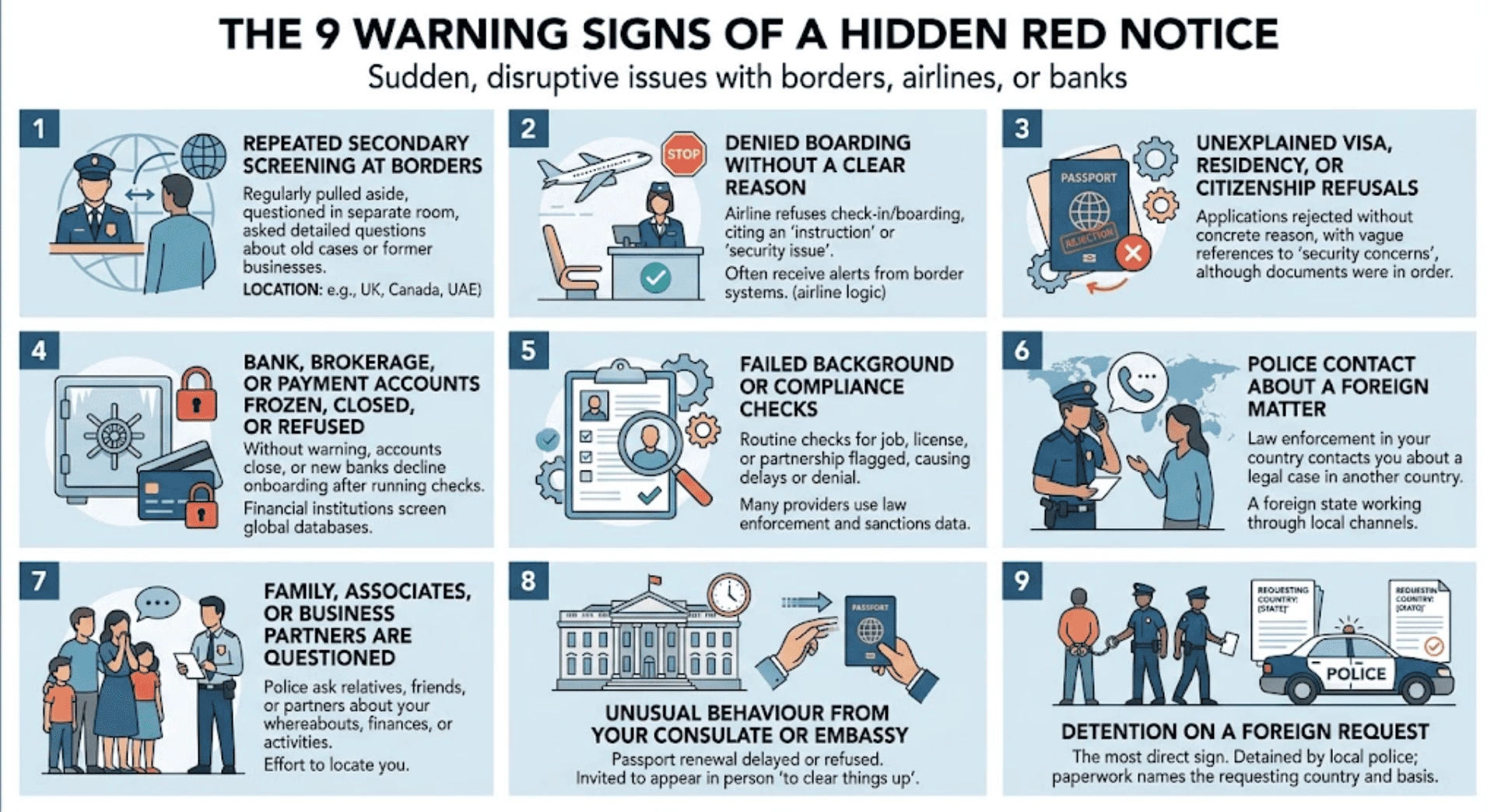
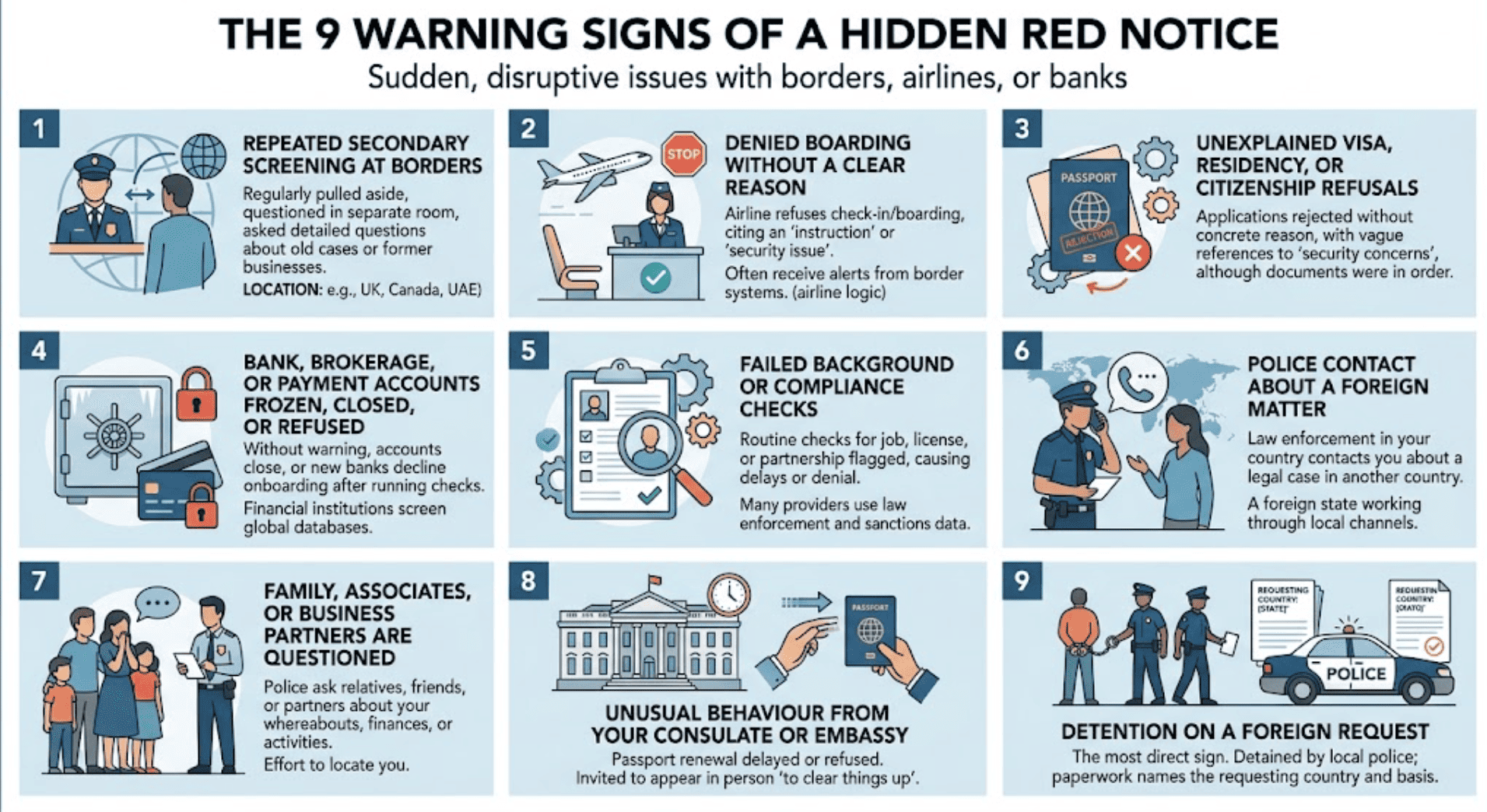
Because most Red Notices are confidential, the first clue often comes from a sudden, disruptive encounter with border officers, airlines, or banks. Here are the nine signs we see most often.
Repeated Secondary Screening at Borders. You are regularly pulled aside, questioned in a separate room, or asked detailed questions about an old case or a former business, especially in countries with close ties to the state you suspect issued the notice.
Denied Boarding Without a Clear Reason. The airline refuses check-in or boarding, citing an “instruction” or “security issue” and cannot explain further. Airlines often receive alerts from border systems before you reach the gate.
Unexplained Visa, Residency, or Citizenship Refusals. An application gets rejected without a concrete reason, or with only a vague reference to “security concerns,” although your documents were in order.
Bank, Brokerage, or Payment Accounts Frozen, Closed, or Refused. Without warning, your bank closes your account, or a new bank or broker declines to onboard you after running its checks. Financial institutions use global compliance databases that screen for Interpol alerts and related risk flags, and a match can trigger their internal risk procedures.
Failed Background or Compliance Checks. A routine check for a job, professional licence, or business partnership is flagged, causing delays or denial. Many screening providers draw on law enforcement and sanctions data.
Police Contact About a Foreign Matter. Law enforcement in your own country contacts you about a legal case in another country. This is a strong signal that a foreign state is working through local channels.
Family, Associates, or Business Partners Are Questioned. Police start asking your relatives, friends, or partners about your whereabouts, finances, or activities. This suggests an active effort to locate you.
Unusual Behaviour From Your Consulate or Embassy. Passport renewal is delayed or refused, or you are invited to appear in person “to clear things up.” This does not always mean a notice exists, but combined with other signs it is worth checking.
Detention on a Foreign Request. The most direct sign, and the point where time for a quiet check has run out. You are detained by local police, and the paperwork names the requesting country and the basis for the request.
Does one of these signs mean I definitely have a Red Notice?
No, and it is important to say so. Every sign above has innocent explanations: a name match with another person, ordinary bank “de-risking,” random secondary screening, or an incomplete visa file. What matters is the pattern. One isolated event is rarely a reason for alarm. Several signs together, especially if you have an unresolved case, a past dispute, or a complaint abroad, are a reason to check confidentially rather than wait.
Could the Problem Come From a Different Database?
Not every alert comes from a Red Notice. Similar effects can be caused by:
- A national wanted list or arrest warrant that has not been sent to Interpol at all.
- An Interpol diffusion. This is a less formal request that a member country’s National Central Bureau (NCB) sends directly to some or all other members, without the same advance review by the General Secretariat that a Red Notice undergoes. It can lead to the same practical problems.
- Regional systems, such as Schengen alerts in Europe.
- Sanctions lists and commercial screening databases used by banks and employers.
- A travel ban or a local court order. See our explanation of a travel ban in the UAE.
The remedy depends on the source, which is why identifying it correctly is the first step.
How Can I Find Out For Sure If I Have a Red Notice?
The only certain way is to file an access request with the Commission for the Control of Interpol’s Files (CCF).
First, an obvious but incomplete step: search Interpol’s public “View Red Notices” database. A clear result is not reassuring, because an absence from the public list does not mean a confidential, law-enforcement-only notice doesn’t exist.
The real process goes through the CCF, an independent body that handles requests for access to, correction of, or deletion of data in Interpol’s systems. You submit a formal request, provide authenticated proof of identity, and ask for all data held on you. The CCF handles requests confidentially, but to assess them it normally consults the country that supplied the data. Processing takes months, and complex deletion requests take longer. This is why we recommend preparing the request with a lawyer who has handled such cases.
What Are My Options If a Red Notice Exists?
If a Red Notice is confirmed, you have the right to challenge it. The goal is to request its deletion from Interpol’s systems. This isn’t an appeal of the original criminal case. It is an argument that the notice itself violates Interpol’s own rules.
The strongest argument is often a violation of Article 3 of Interpol’s Constitution, which forbids the organization from any intervention or activity of a political, military, religious, or racial character. Other grounds for deletion include:
- The underlying matter is a civil or private dispute, not a “serious ordinary-law crime” as Interpol’s rules require.
- The requesting country cannot show a valid, enforceable arrest warrant or court decision.
- The notice breaches the principle of ne bis in idem (double jeopardy). Within the EU, this was addressed by the Court of Justice of the European Union in WS v Bundesrepublik Deutschland.
- The case involves serious human rights concerns, such as a flagrant denial of the right to a fair trial.
- You hold refugee status, and the notice was issued by the country you fled.
- The limitation period has expired and the warrant is no longer enforceable.
A deletion request is a serious legal filing. It requires a detailed submission of factual and legal arguments backed by evidence, such as documents proving the case is a commercial dispute or reports showing political motivation. challenging and removing improper Red Notices.
Does a Red Notice Automatically Lead to Arrest in the U.S.?
No. The United States does not treat a Red Notice, by itself, as a sufficient basis for arrest. U.S. authorities need a warrant issued by a U.S. court, which is typically sought only after the foreign country submits a formal extradition request through diplomatic channels. Still, a Red Notice triggers alerts within agencies like DHS and the FBI, and it can lead to questioning at the border and a review of your visa or immigration status.
What Should You Do If You Notice These Warning Signs?
- Don’t test the situation by travelling. If you suspect a notice, avoid flights and border crossings, particularly through countries with active extradition cooperation, until your status is clear.
- Write down and keep everything: dates of border stops, names on refusal letters, bank closure notices, and any messages from authorities.
- Don’t contact the foreign authorities, the claimant, or a consulate on your own, and don’t make statements that could be used in the requesting country.
- Gather your case history: any old dispute, complaint, judgment, or settlement abroad, with translations if available.
- Get a confidential check through a lawyer. Our lawyers can identify the likely source of the alert and, if needed, prepare a Request for Access to the CCF.
- If you are stopped at a border, stay calm, don’t sign documents you don’t understand, ask for an interpreter and a lawyer, and contact our team immediately.
Mistakes that make the situation worse
- assuming that a clean result on Interpol’s public page means you are safe;
- waiting for an arrest before taking action;
- contacting the requesting authorities directly to “explain”;
- using several unconnected lawyers for the CCF request and the local case.
Facing a Potential Red Notice? Take Action Now.
The warning signs of a Red Notice are subtle, but the consequences are serious. If you have any reason to suspect a notice has been issued against you, acting quickly and strategically is your best protection. Do not wait for an arrest at an airport to confirm your concerns.
Our legal team has experience navigating Interpol’s systems and challenging improper Red Notices. We can help you find out whether a notice exists, build a case for its removal, and protect your freedom and future. Contact us for a confidential consultation.
⚠️ Time is critical — every day matters
Get a free case assessment
Our team specialises in cases with an international element. We review applicable treaties, assess risks, and prepare an action plan.
Frequently Asked Questions About Hidden Interpol Red Notices
Can you have an Interpol Red Notice without knowing it?
Yes. Most Red Notices are visible only to law enforcement, and the person concerned is not informed. Many people first learn about one when they are stopped at a border, refused boarding, or have a bank account closed.
Can a bank close my account because of a Red Notice?
It can happen. Banks and brokers screen clients against compliance databases that may include Interpol-related data, and a match can trigger an account freeze, closure, or refusal to onboard. However, banks close accounts for many other reasons, so a closure alone is not proof of a notice.
How can I check whether I have a Red Notice?
Start with Interpol’s public “View Red Notices” page, but remember that most notices are not listed there. The definitive method is a Request for Access to the CCF, ideally prepared with a lawyer.
What does a Red Notice from Interpol mean?
It means a member country asks law enforcement worldwide to locate and provisionally arrest a person pending extradition or similar action. It is not an international arrest warrant, and each country decides for itself how to act on it.
What is the difference between a Red Notice and a diffusion?
A Red Notice is issued by Interpol’s General Secretariat after a review. A diffusion is a less formal request that a member country’s National Central Bureau sends directly to other countries. Both can lead to a border stop or provisional arrest, and both can be challenged through the CCF.
Is the public Interpol wanted list the full list of Red Notices?
No. The public list shows only a small share of active notices, chosen by the requesting countries for publication. The majority are confidential.
Should I travel if I notice these warning signs?
We advise against it until your status is confirmed. If a non-public notice exists, entry or transit can end in provisional detention. A confidential check through a lawyer is the safer first step.
This article is published by an independent law firm for informational purposes only and does not represent or claim affiliation with any government body, international organization, or official authority.