


 Home
HomeDeportation vs. Extradition from the UAE — What is the Difference
A British national was detained at Dubai International Airport in February 2026 after overstaying his work visa by 90 days. Immigration authorities issued a deportation order on the spot. Three days later, he learned that Interpol had also issued a Red Notice at the request of French prosecutors seeking his extradition for alleged financial fraud. His legal team had to distinguish between the administrative deportation process—handled by UAE immigration—and the extradition request, which required Federal Court review and could take six months or longer.

What Is Deportation in the UAE? (The Administrative Removal Process)
Deportation in the UAE is the involuntary removal of a foreign national for administrative or criminal reasons. The UAE official portal confirms two pathways: legal deportation (by court order after a felony sentence under Article 121 of the UAE Penal Code) and administrative deportation (for public interest, security, morals, or health, ordered by the Federal Public Prosecutor or the GDRFA under Federal Law No. 6 of 1973). The critical point: administrative deportation requires no criminal conviction. It’s purely an immigration enforcement measure.
What triggers administrative deportation? Overstaying a UAE visa beyond the grace period (typically 30 days after expiry). Working without a valid work permit or residency visa. Conduct deemed contrary to public morals or security. A security alert from UAE intelligence or police. The GDRFA or Federal Public Prosecutor issues a written deportation order in Arabic and English, citing specific legal grounds. No criminal trial. No court judgment required—though you can appeal.
Once that order lands, you typically get 10 to 30 days to settle affairs, challenge the decision, or leave voluntarily. If you own property, run a business, or have pending legal matters, authorities may extend this grace period on bail—but never beyond three months. Miss that window and you face detention, forced removal, and a re-entry ban (usually 5 to 10 years, sometimes permanent). Here’s what most people don’t grasp: voluntary exit and forced deportation are not the same. Leave on your own before the deadline, and future visa applications may still be possible. Get deported, and the ban is recorded on your immigration file and shared with every GCC member state.
Deportation vs. Extradition from the UAE — What is the Difference
НOur team specializes in cases with an international element. We will review the applicable treaties, assess the risks, and prepare an action plan.
Contact a lawyer →What Is Extradition in the UAE? (The International Criminal Surrender)
Extradition in the UAE is a judicial process. It’s governed by Federal Decree-Law No. 39 of 2006 on International Judicial Cooperation in Criminal Matters (amended by Federal Decree-Law No. 38 of 2023). A foreign government requests you formally. The UAE Federal Public Prosecutor examines the request. Then the Federal Court of First Instance reviews it. Then mandatory appeal to the Federal Court of Appeal. Only then—if both courts say yes—are you handed over.
The UAE is party to bilateral extradition treaties with the United Kingdom (2006), France, Egypt, Jordan, and others. It’s also bound by multilateral agreements under the Arab League Convention on Extradition and the GCC Security Agreement. Note: the UAE has no comprehensive extradition treaty with the United States, though the two countries cooperate on mutual legal assistance and handle extradition requests case-by-case through diplomatic channels.
Federal Law No. 34 of 1992 (Criminal Procedure Code, Chapter 6) and Federal Decree-Law No. 39 of 2006 set the legal foundation. Article 2 introduces a critical requirement: dual criminality. The conduct must be a crime under both UAE law and the law of the requesting state. Both jurisdictions must punish it by at least one year imprisonment. Political offenses, military offenses, and crimes of a racial or religious character are excluded—protected by Article 3 of the Interpol Constitution and UAE practice. The UAE courts will also refuse extradition if there’s a genuine risk of torture, inhuman treatment, or a flagrant denial of justice in the requesting country, following the principle established in Soering v. United Kingdom (European Court of Human Rights, Application no. 14038/88, 7 July 1989).
Extradition moves slowly. Minimum three to six months, often far longer if you contest it. The requesting country submits a formal request through diplomatic or Interpol channels, backed by an arrest warrant, charging documents, and evidence showing a prima facie case. The Federal Public Prosecutor reviews it for treaty compliance, dual criminality, and human rights. If approved, it goes to the Federal Court of First Instance for judicial scrutiny. You have the right to legal counsel, the right to challenge the evidence, and the right to argue refusal grounds: no dual criminality, political offense, risk of unfair trial, double jeopardy. The court’s decision gets mandatory appeal to the Federal Court of Appeal. If extradition is approved, surrender happens within 30 to 60 days of the final court order—subject to any diplomatic assurances or conditions the UAE imposes.
US case law illustrates the judicial rigor applied to extradition. Doherty v. United States, 908 F.2d 1108 (2d Cir. 1990), examined whether Irish Republican Army activities qualified as political offenses exempt from extradition. The court held that violent acts—even if politically motivated—lose protection if they breach international humanitarian norms. UAE courts apply the same logic: terrorism, crimes against humanity, and war crimes are not protected by the political offense exception and are extraditable if dual criminality and treaty requirements exist.
Five Core Differences Between Deportation and Extradition in the UAE
Here’s how they diverge:
| Criterion | Deportation | Extradition |
|---|---|---|
| Legal trigger | Immigration or administrative violation (visa breach, overstay, public-interest concern); no criminal conviction required | Criminal offense in requesting country; formal extradition request supported by arrest warrant and evidence |
| Decision-maker | GDRFA or Federal Public Prosecutor (administrative authority); courts involved only if deportation follows a criminal sentence | Federal Public Prosecutor (prosecutorial review) and Federal Court of First Instance and Federal Court of Appeal (judicial review) |
| Dual criminality | Not required—deportation is an immigration measure, not dependent on the conduct being criminal in UAE | Required under Article 2, Federal Decree-Law No. 39/2006—conduct must be criminal in both UAE and requesting state, punishable by at least one year imprisonment |
| Appeal rights and timeline | Appeal to Federal Public Prosecution or special committee; decision typically within 20–30 days; grace period for voluntary exit 10–30 days (max 3 months on bail) | Judicial review by Federal Court of First Instance; mandatory appeal to Federal Court of Appeal; proceedings take 3–6 months minimum, often longer for contested cases |
| Visa and re-entry ban | Deportation results in UAE re-entry ban (5–10 years standard, potentially permanent); ban recorded on immigration file and shared with GCC states | Extradition results in criminal record, loss of UAE residency, and prohibition on return; individual is surrendered to requesting state, not sent to home country |
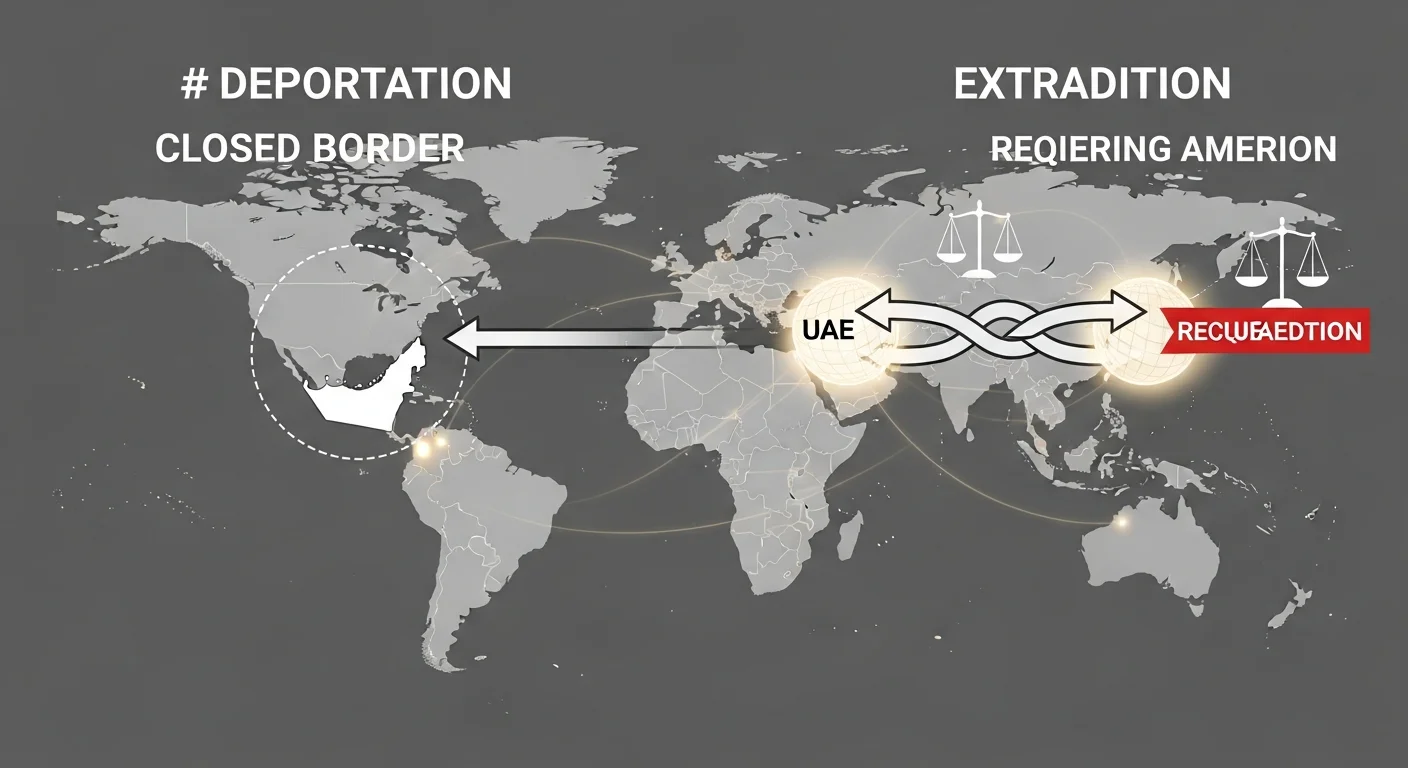
One final distinction: repatriation versus surrender. Deportation sends you home. You’re repatriated to your country of nationality or residence. Extradition sends you to the prosecuting state—which may be nowhere near home. A French national detained in the UAE and facing extradition to the United States won’t be sent to France. The UAE will surrender that person directly to US custody for transport to the United States for trial or sentencing. Your home country doesn’t get a say.
The Deportation Process in the UAE: Step-by-Step Legal Route
Step 1: Issuance of deportation notice. The GDRFA or Federal Public Prosecutor issues a written deportation order in Arabic and English, citing the specific violation or ground (Article 121 of the UAE Penal Code for post-conviction deportation; Federal Law No. 6 of 1973 and Ministerial Decree No. 16 of 2009 for administrative deportation). The notice specifies the reason—overstay, visa violation, security concern, or public-interest ground—and sets a deadline for voluntary exit or appeal. You’ll receive it by hand delivery, registered mail, or through the UAE immigration system. From this moment, your clock starts ticking.
Step 2: Grace period and voluntary exit. Most deportation notices grant 10 to 30 days to leave voluntarily or file an appeal. Own property or have business interests? You can request an extended grace period on bail, up to three months maximum under UAE regulations. This matters: voluntary exit during the grace period often avoids a forced deportation record on your file, which can affect future visa applications depending on the violation’s severity. Miss this window, and you lose that advantage.
Step 3: Filing an administrative appeal. You can appeal to the Federal Public Prosecution or request review by a special GDRFA committee. Submit within the grace period—typically 10 days from the deportation notice date. Your appeal needs teeth: visa copies, residency permits, employment contracts, property deeds, medical reports if health is relevant, anything that supports your case. The review takes 20 to 30 days. Approval suspends or cancels the order. Denial means execution proceeds. The risk: if your appeal is weak or missing documents, you’ve wasted those critical days.
Step 4: Deportation execution. When an appeal fails or time runs out, the GDRFA executes the order. You’re detained (if not already held), escorted to the airport, and placed on a commercial or charter flight home. Your residency visa is cancelled immediately. A re-entry ban lands on your file: 5 to 10 years for standard violations, potentially permanent for serious offenses like felony convictions, security threats, or repeated immigration violations. This ban feeds into the GCC Security Agreement database and travels across member states.
Worth knowing: GDRFA annual reports (2022–2023) show roughly 95% of deportation cases resolve administratively without court involvement. Most stem from visa overstays, unauthorized work, or voluntary exits after notice. Only a small fraction involve forced removal after failed appeals or detention for non-compliance.
The Extradition Process in the UAE: Court-Based Criminal Surrender
Step 1: Formal extradition request. A requesting country—say the United States, the United Kingdom, or France—submits a formal request to the UAE Federal Public Prosecutor through diplomatic channels or Interpol. They must provide: a certified arrest warrant or judgment copy; facts and the legal characterization of the offense; prima facie evidence (witness statements, financial records, forensics); and proof that dual criminality applies under Article 2 of Federal Decree-Law No. 39/2006. An Interpol Red Notice often precedes the formal request, flagging UAE authorities to detain you pending the full submission.
Step 2: Prosecutorial review. The Federal Public Prosecutor vets the request against treaty obligations, dual criminality, and human rights standards. They check: Is the offense criminal in both the UAE and requesting state? Is it punishable by at least one year imprisonment in both jurisdictions? Does it fall outside Interpol’s ban on political, military, religious, or racial offenses (Article 3, Interpol Constitution)? Is there genuine risk of torture, inhuman treatment, or a fundamentally unfair trial in that country, per *Soering v. United Kingdom* and UAE human rights law? Pass this gate, and your case moves to Federal Court.
Step 3: Judicial review by Federal Court of First Instance. You get a court hearing. You have the right to a lawyer, to examine the requesting country’s evidence, and to mount legal defenses. Common ones: the conduct isn’t criminal under UAE law (lack of dual criminality); the offense is political, not extraditable; you’ve already been tried and acquitted elsewhere (double jeopardy); the requesting country poses genuine risks to your safety or fair trial; or the statute of limitations expired under UAE or requesting-country law. The Court issues a written ruling approving or refusing extradition, with legal reasoning cited.
Step 4: Mandatory appeal to Federal Court of Appeal. Either side can appeal—you or the Federal Public Prosecutor acting for the requesting country. The appellate court re-examines the legal arguments, dual criminality application, and treaty compliance. This decision is final under UAE law, though you can seek diplomatic intervention or petition international human rights bodies if you believe fundamental rights were violated. Expect two to four additional months here.
Step 5: Surrender to requesting state. Approval at appellate level means transfer within 30 to 60 days of the final order, subject to any conditions the UAE imposes—assurances that the death penalty won’t be imposed, for instance, or that you’ll return to serve time. You’re transported under guard to the requesting state and handed to law enforcement or courts for prosecution or sentencing. Your UAE residency cancels. Return is barred until criminal proceedings close and any sentence is served.
Timing reality: Three to six months minimum from formal request to final court decision. Complex cases with contested evidence, multiple appeals, or diplomatic negotiations stretch to 12–18 months or beyond. This dwarfs deportation, where administrative processing runs 10–30 days without appeal, or 20–60 days if you challenge it.

How to Check Deportation Status in the UAE
Several official channels exist to verify your status. The UAE Federal Authority for Identity and Citizenship (ICA) runs an online portal at smartservices.ica.gov.ae—registered users can view visa validity, immigration standing, and any deportation or travel bans. Walk into a GDRFA customer service center in Dubai, Abu Dhabi, or Sharjah with your passport and Emirates ID for an in-person check. For criminal or security-based deportation orders, contact the UAE Federal Public Prosecution directly. You’ll need your passport number, Emirates ID, and visa file number. An active order will display the reason, issuing authority, and re-entry ban duration.
Interpol Red Notice checks operate separately from deportation status inquiries. Suspect you’re flagged? Submit a request to the Commission for the Control of Interpol’s Files (CCF) to confirm whether a Red Notice exists in your name. The CCF process takes 90 to 130 days from application—which means if you file today, expect an answer by April or May. Legal counsel can push for expedited requests and coordinate with UAE authorities to block provisional arrest based on a Red Notice while extradition challenges move forward.
UAE Deportation Rules: Grounds, Bans, and Administrative Deportation
Federal Law No. 6 of 1973 on Entry and Residence of Foreigners, Article 121 of the UAE Penal Code, and Ministerial Decree No. 16 of 2009 set the framework. Two pathways exist: Legal deportation by court order after a felony conviction with custodial punishment (Article 121); and Administrative deportation ordered by the GDRFA or Federal Public Prosecutor for public interest, national security, morals, or health—no criminal conviction required.
Administrative deportation triggers include: visa overstay past the grace period (30 days after expiry); working without a valid permit or residency visa; conduct deemed immoral or contrary to UAE public policy (prostitution, drug use, public intoxication); posing a national security risk through intelligence reports, banned-organization links, or foreign criminal history; or simply being deemed undesirable for economic, social, or security reasons. The Federal Public Prosecutor wields broad discretion here—a valid visa or residency permit is no shield if public interest demands removal.
Re-entry bans following deportation typically run 5 to 10 years—but can be permanent for serious violations. The length depends on what you did: 5 years for overstay or minor immigration violations; 10 years for criminal convictions, security concerns, or repeated offenses; permanent bans for felonies involving violence, drug trafficking, or national security threats. This matters because the ban gets recorded in the UAE immigration database and shared across GCC member states, meaning you’ll face the same restrictions in neighboring countries. Under Article 28 of Federal Law No. 6 of 1973, a deported person cannot return to the UAE without special permission from the Director General of the Federal Authority for Identity and Citizenship. Getting that permission requires a formal petition, evidence you’ve genuinely changed, and approval from UAE immigration authorities—a process that rarely succeeds within the first few years of your ban.
What Is the Difference Between Extradition and Surrender?
Extradition and surrender sound like the same thing. They’re not—at least not technically. Extradition refers to the transfer of a person from one country to another under a bilateral or multilateral treaty, after a judicial review process. Surrender is the term used between countries sharing a common legal framework—like the European Arrest Warrant (EAW) system under EU Framework Decision 2002/584/JHA. Under the EAW, member states “surrender” individuals rather than “extradite” them because the process relies on mutual recognition of judicial decisions instead of traditional extradition treaties.
In the UAE, this distinction barely exists. The term extradition covers all judicial cooperation processes involving the transfer of individuals to foreign states under treaty obligations. UAE law doesn’t use “surrender” at all. The practical outcome is identical: you get handed over to the requesting state for prosecution or sentencing. What matters more in UAE practice is the difference between extradition and deportation. Deportation sends you back to your home country (repatriation). Extradition sends you to the country prosecuting you—which might not be your home country at all.
Reason for Deportation in the UAE: Common Violations and Security Grounds
The reasons people get deported from the UAE fall into distinct categories. Visa overstay happens when you stay past your visa expiry date plus the grace period—usually 30 days. Unauthorized employment means working without a valid permit or on a visa that doesn’t allow work. Criminal convictions trigger court-ordered deportation under Article 121 of the UAE Penal Code. Security concerns can be based on intelligence reports, links to prohibited groups, or a criminal history elsewhere. Moral violations cover conduct deemed contrary to UAE public morals: prostitution, drug use, public intoxication, cohabitation outside marriage. Public health or economic grounds can apply if you pose a health risk or can’t support yourself financially.
Security-based deportation works differently. It doesn’t require a criminal conviction or formal charges. UAE authorities can issue an administrative deportation order on the basis of intelligence assessments, Interpol alerts, or reports from foreign governments. Your appeal rights are limited because the grounds are typically classified—you won’t even know the full details of why this is happening. Your lawyer can request a review from the Federal Public Prosecution or petition for disclosure under UAE administrative law, but don’t expect success if national security is involved. Expect instead a long wait and repeated denials.





FAQ
What is the difference between deportation and extradition?
Deportation is an administrative removal ordered by the GDRFA or Federal Public Prosecutor for immigration violations, public-interest concerns, or security reasons. No criminal conviction is required, and no treaty is involved. Extradition, governed by Federal Decree-Law No. 39 of 2006, is a judicial process: a foreign government makes a formal request, prosecutors review it, and the Federal Court of First Instance and Federal Court of Appeal must approve it before you’re handed over to face criminal charges or serve a sentence. The outcome differs too. Deportation sends you back to your home country. Extradition sends you to whichever state is prosecuting you.
How to check deportation status in UAE?
Three options exist. Use the Federal Authority for Identity and Citizenship (ICA) online portal at smartservices.ica.gov.ae (you’ll need registration and an Emirates ID). Visit a GDRFA customer service center in Dubai, Abu Dhabi, or Sharjah in person with your passport and Emirates ID. Contact the UAE Federal Public Prosecution if the deportation order came on criminal or security grounds. The inquiry will reveal whether an order is active, why, which authority issued it, and your re-entry ban length. A lawyer can push for expedited inquiries and help you appeal.
What are UAE deportation rules?
Federal Law No. 6 of 1973 on Entry and Residence of Foreigners, Article 121 of the UAE Penal Code, and Ministerial Decree No. 16 of 2009 establish the framework. Deportation can be legal—a court order after a felony conviction—or administrative, ordered by the GDRFA or Federal Public Prosecutor for public interest, security, morals, or health grounds. Visa overstay, unauthorized employment, criminal convictions, security concerns, and moral violations are all grounds. Re-entry bans run 5 to 10 years (potentially forever for serious violations). A deported person can’t return unless the Director General of the Federal Authority for Identity and Citizenship grants special permission under Article 28.
What is administrative deportation in UAE?
Administrative deportation is removal ordered by the GDRFA or Federal Public Prosecutor for public-interest, security, moral, or health grounds—without any criminal conviction or court judgment. Federal Law No. 6 of 1973 and Ministerial Decree No. 16 of 2009 govern it. The Federal Public Prosecutor or authorized representative can order deportation even if you hold a valid visa or residency permit when public interest, security, morals, or health demands it. You may get a grace period (10 to 30 days, potentially up to 3 months on bail) to settle your affairs and leave voluntarily. If you don’t, deportation is executed and a 5- to 10-year re-entry ban takes effect immediately.