


 Home
HomeHow to Report a Cybercrime in the UAE: Step-by-Step Guide (2026 Update)

Cybercrime is increasingly becoming sophisticated in the UAE’s hyper-digital space, affecting individuals, businesses, and government institutions. From phishing scams and financial fraud to social media blackmail and corporate data breaches, these cyber-security risks are real and rising. As such, the UAE’s authorities have developed a robust legal framework to raise awareness and combat cybercrime.
High-profile cases like the 2021 hacking of a UAE bank customer’s account and the arrest of international fraud syndicates in Dubai highlight how sophisticated these crimes have become. Fortunately, the UAE government, through platforms like the Dubai Police eCrime portal (ecrime.ae) and the Ministry of Interior’s (MOI) Cybercrime Reporting Service, has developed fast, secure, and accessible systems to enhance online safety. These platforms demonstrate how to report cyber-crime in the UAE and seek justice for online threats.
Whether you’re a resident or visitor, understanding your legal options and the proper channels to report online crimes is your first step toward protection and accountability. A poorly drafted statement can slow down the investigation or even lead to no consequences at all. Our legal company provides full support in filing a complaint about cybercrime in the UAE, whether through the eCrime portal, Smart Police Station, or directly with the police department.
What is cybercrime?
Cybercrime refers to any criminal activity committed using a computer, networked device, or other emerging technologies. In the UAE, this includes crimes committed online, through smartphones, or over social media, with the intent to defraud, harass, steal, impersonate, or harm individuals, organizations, or national security.
The UAE’s Federal Law No. 34 of 2021 on Combating Rumors and Cybercrimes provides a comprehensive legal framework for prosecuting such digital threats. This UAE law imposes strict penalties, including hefty fines and imprisonment, to deter misuse of digital platforms and protect citizens and residents from online threats.
Types of cybercrimes you can report in the UAE
The Dubai police have reported an uptick in online scams and other digital threats in recent years. Understanding these forms of cybercrimes is crucial for knowing when and how to report them. Here are the most common types of digital crimes in Dubai and the UAE:
- Online Fraud and Phishing Schemes
Digital criminals impersonate banks, government entities, or known brands to trick victims into providing sensitive information such as passwords, credit card details, or Emirates ID numbers. Many victims receive fake SMS messages or emails claiming suspicious activity on their accounts.
In March 2025, the Dubai Police arrested a gang impersonating representatives of the Consumer Rights Protection Department to gain access to people’s bank details. The gang used sophisticated fraudulent methods to convince their victims to surrender their bank account details and illegally withdraw money from their accounts. - Identity Theft and Impersonation
Cybercriminals may use stolen photos or personal details to create fake profiles on social media or messaging apps like WhatsApp and Telegram. These fake accounts are often used to scam contacts, request money, or damage reputations. - Cyberbullying and Online Harassment
Whether it’s abusive messages, blackmail through private images, or character defamation, cyberbullying is a serious offense in the UAE. The country’s strict cyber crime laws protect victims, especially minors and women, from online threats and psychological harm. Defamation on the internet or through other communication services is particularly severely punished, with fines reaching 500,000 dirhams, and imprisonment is possible. - Hacking and Unauthorized Access
This refers to any unauthorized attempt to gain access to corporate or private websites, email accounts, cloud storage, or personal information. Even a single attempt at hacking is considered a crime and may lead to deportation. - Sextortion and Blackmail
One of the fastest-growing forms of cybercrime in the UAE involves criminals luring victims into private video calls and then threatening to leak intimate content unless a ransom is paid. These crimes are often run by organized international networks, but can be reported and prosecuted locally. - Fake News and Rumors
Spreading misinformation, especially about public health, religion, or state authorities, is a punishable offense. UAE’s cyber crime law safeguards the integrity of electronic communications and has zero tolerance towards spreading false information. That’s particularly important when publishing information online affects national unity or public order. - Financial fraud
These digital crimes include phishing (fake links and websites for stealing passwords and banking data), money laundering, forging online invoices and bills, and “investment access” schemes that promise high returns only to disappear with the money. Financial manipulations and using illegal funds are strictly punished under Federal Decree-Law No. 34 of 2021. Offenders face a fine of up to 2 million dirhams and imprisonment. Victims of such schemes—sometimes referred to as “cheating cases”—can file a complaint through the same eCrime channels described below.
If you are unsure how to document an incident or need legal support, contact our legal team. We will help record the violation, collect evidence, and protect your interests before the UAE law enforcement authorities.
| Criteria | MOI eCrime Portal | Dubai Police eCrime | Abu Dhabi Cybercrime |
|---|---|---|---|
| Coverage | All UAE (federal) | Dubai only | Abu Dhabi only |
| Response Time | 5–7 working days | 3–5 working days (priority for financial crimes) | 7–10 working days |
| Supported Languages | Arabic, English | Arabic, English, Urdu, Russian, Chinese | Arabic, English |
| How to Report | Online only (UAE Pass required) | Online, via mobile app, or in person at police stations | Online or via hotline (8002626) |
| Best For | Inter-emirate crimes, cybercrimes related to terrorism | Urgent fraud cases (especially banking/online shopping scams) | Business Email Compromise (BEC), government data breaches |
| Anonymous Reporting | Possible (but slower) | Possible via hotline | Possible via hotline |
| Case Updates | SMS/email notifications | Direct contact with investigator | Case tracking online |
| Mobile Access | MOI UAE app | Dubai Police app | AD Police app |
| New | AI fraud detection | Instant freezing of scammer’s UAE bank | Blockchain-based evidence storage account |
Where to report cybercrimes in the UAE (2026)
The UAE government has developed robust information technology systems to enhance public awareness of these growing digital threats and prevent future incidents. Here are three main channels available to report incidents like online fraud, scams, hacking attempts, phishing schemes, and others:
1. UAE Ministry of Interior (MOI) eCrime Service
The MOI eCrime portal is the UAE’s national cybercrime reporting portal for filing complaints on offenses committed outside Dubai or involving several Emirates. The platform accepts remote reports of suspicious online activities by UAE citizens, residents, and tourists. You only need a verified profile in the UAE Pass system for identity verification and data security during submission.
Individuals can report cyber crimes through the website (www.moi.gov.ae → Services → eCrime Reporting) or the MOI UAE mobile app. The incident report must specify all the case’s circumstances, including date, type of incident, description of the suspect’s actions, links, or screenshots (if available).
After submitting the complaint, the user receives a case number to track the review progress, and the response comes within 5-7 days. The platform supports English and Arabic, and it’s suitable for incidents related to crimes with signs of terrorist orientation. It is also used for appeals from legal entities if the violations concern large organizations or public systems.
2. The Cybercrime Department of the Dubai Police
The Dubai Police is among the most technologically advanced services in the UAE for filing cyber crime complaints. Unlike the federal portal, more submission methods are available here: through the official website www.dubaipolice.gov.ae, the mobile application Dubai Police App, or by a personal visit to a police station. Note that Dubai Police does not accept cybercrime complaints by email — the official eCrime portal (www.ecrime.ae), the Dubai Police App, or the 901 call center are the only recognized channels for submitting a report.
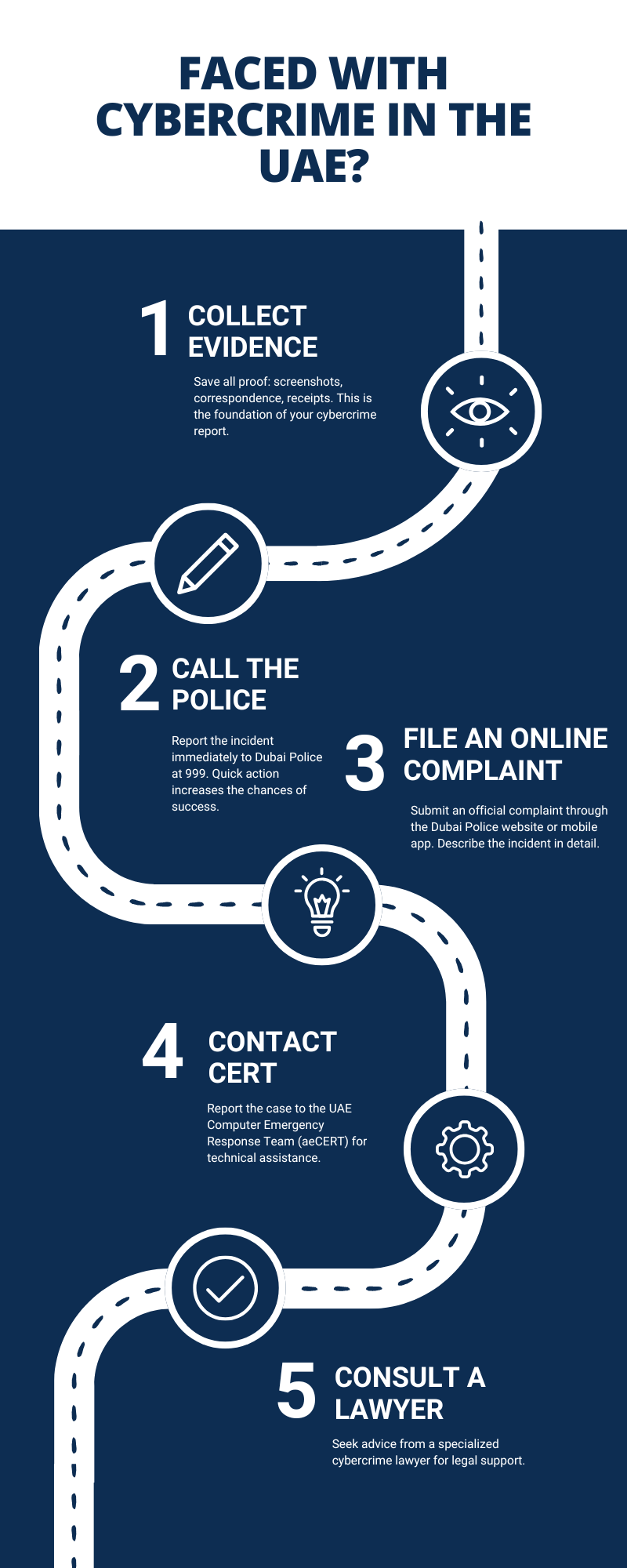
Here’s how to report cyber crime in the UAE to the Dubai Police:
- Indicate the type of violation
- Outline the circumstances of the case and attach the evidence (correspondence, receipts and screenshots)
- Track the status of your application
After completing the reporting process, the competent authorities directly contact the victims, and an investigator is assigned to the case. Anonymous cybercrime reports aren’t allowed, and the user must identify themselves through UAE Pass or provide contact details.
The processing of complaints takes 3–5 working days. One of the innovations is the automatic freezing of suspicious bank accounts in the UAE upon confirmation of fraud, quickly preventing further transactions.
3. Abu Dhabi Police Department for Combating Electronic Crimes
Abu Dhabi residents can report cyber crime through a separate division — the Abu Dhabi Cyber Crime unit — that handles digital offenses within the local police structure. The division focuses on serious cyber incidents like breaches of government resources, corporate email compromise (BEC), personal data leaks, and attacks on digital infrastructure.
The application can be submitted in two ways:
- Through the official website www.adpolice.gov.ae or using the mobile application – AD Police App.
- A hotline 8002626 is also available, where you can report a crime and receive consultation, including anonymously.
The online submission form is intuitive for users to easily describe the incident, attach evidence, and receive a unique case number when submitting reports. Case tracking is done through the portal or by phone. The procedure takes 7 to 10 business days, depending on the complexity of the case.
In 2025, the department implemented blockchain-based evidence storage technology, enhancing the reliability of digital evidence and making the investigation process more transparent. Despite its regional nature, the Abu Dhabi police structure actively collaborates with other emirates when it comes to transferring cases or searching for suspects.
The table systematizes the key differences and features of methods for filing complaints about cybercrimes:
Documents required for filing a complaint about cybercrime
To expedite the complaint review process and increase its chances of a successful investigation, it is important to provide the following documents and evidence:
- Identity document: Applicant’s passport or Emirates ID. If the complaint is filed on behalf of a company, a copy of the commercial license and documents confirming the representative’s authority.
- Screenshots and correspondence: Visual evidence of the crime: messages, chats in messengers, comments, posts on social networks, emails, screens of banking transactions, etc.
- Links to resources: Indication of pages, websites, or accounts through which the offense was committed.
- Technical information: IP addresses, sender’s e-mail, phone numbers, payment data, transaction data, and log files (if available).
- Financial documents: In cases of financial crimes, receipts, bank statements, transfer confirmations, contracts, and correspondence with fraudsters.
- A complaint in written form: A brief and structured description of the incident: when it happened, what exactly happened, how you were affected, what assistance you expect.
Most applications are submitted online through the UAE Ministry of Interior portal, the Dubai Police website, or Abu Dhabi. Important:
- Indicate accurate data – Errors in the passport number, contact information, or incident date may delay the review.
- Choose the correct category of crime – The system allows selecting from the list: fraud, defamation, hacking, threats, blackmail, disseminating false information or illegal content, and others.
- Attach all evidence – Do not delay providing screenshots or documents—it’s better to gather everything in advance.
- Indicate the damage – If you have incurred material or reputational losses, it is important to reflect this in the complaint and specify an approximate amount.
How to protect yourself from cybercrimes
In today’s digital age, cyber threats are increasingly becoming sophisticated, and prevention is your best defense. Whether you’re a UAE citizen, resident, or tourist, taking proactive steps will help you create a safer digital environment and avoid being a victim of cyber threats
Here are practical legal measures that align with the UAE’s new cyber crime law to enhance your digital safety and security:
1. Set Strong, Unique Passwords
- Create passwords with a mix of uppercase, lowercase, numbers, and symbols.
- Avoid using the same password across multiple accounts.
- Use a trusted password manager to store and generate complex passwords.
2. Enable Two-Factor Authentication (2FA)
Activate 2FA on email, social media, and banking apps to add an extra layer of data protection even if your password is compromised.
3. Be Cautious with Personal Information
- Never share your Emirates ID, passport number, banking details, or OTPs via text, email, or social media.
- Be careful what you post publicly on social media. Scammers often collect details to impersonate or blackmail victims.
4. Verify Before You Click
- Don’t click on suspicious links or download attachments from unknown sources.
- Always double-check email senders, especially for official-looking emails that demand urgent action.
- If in doubt, contact the organization directly through official channels.
5. Update Your Devices Regularly
- Keep your phone, laptop, and apps up to date with the latest security patches.
- Install a reputable antivirus and firewall software to detect threats early.
6. Avoid Using Public Wi-Fi for Sensitive Transactions
- Public networks (in cafes, airports, hotels) are easy targets for hackers.
- Use a VPN (Virtual Private Network) when accessing sensitive sites while on unsecured Wi-Fi.
7. Report Suspicious Activity Immediately
If you suspect you’ve been targeted—or notice unusual behavior on your accounts—report it to:
- Dubai Police eCrime Portal: www.ecrime.ae
- MOI eCrime Service: www.moi.gov.ae
Early reporting helps authorities take swift action and may prevent further harm.
8. Educate Your Family and Employees
- Teach children and elderly family members about online dangers like catfishing, cyberbullying, and phishing.
- In businesses, conduct regular cybersecurity awareness training for staff.
Your Digital Security is Your Legal Responsibility – Report cybercrime now!
If you’ve been a victim of online crimes like online fraud, blackmail, hacking, or digital harassment in the UAE, take legal action. The law is on your side, and help is just a click away. Whether you’re in Dubai or any other Emirate, reporting cybercrime is fast, confidential, and fully supported by the authorities.
- Report incidents through the Dubai Police eCrime Portal
- Use the MOI Cybercrime Reporting Service for nationwide cases
- Get legal guidance to protect your rights and pursue justice
Your first step to justice starts with a cybercrime report. Don’t wait— Contact us now and stay protected in the physical and digital world.
FAQ
Can I report a cybercrime anonymously in the UAE?
Yes, in the UAE, there is an option to file a complaint anonymously through official portals such as eCrime.ae or the Dubai Police app. However, with anonymous submissions, it is more difficult to initiate a full investigation, as the authorities will not be able to contact you for clarification of details. If you want to achieve a specific result, it is better to provide your contact information.
What evidence is needed to file a complaint with UAE police?
A written statement with a detailed account of the incident is required. Supporting documents such as correspondence, contracts, photos, videos, and bank statements must be provided. For online or app-based complaints, a verified UAE Pass account is required. All documents in a foreign language must be officially translated into Arabic.
Can a lawyer help with international cases involving extradition and cybercrime in the UAE?
Yes, a qualified lawyer specializing in international law and UAE law can provide substantial assistance. They can challenge the legality of an extradition request or Interpol notice and represent a client before local courts. In cybercrime cases, a lawyer can help navigate the UAE Cybercrime Law (Federal Decree No. 34 of 2021). Engaging legal counsel early significantly improves the chances of a favorable outcome.
Can I be arrested in the UAE for cybercrime committed outside the country?
Yes, in certain circumstances. The UAE asserts jurisdiction over cybercrime that affects UAE persons, companies, or systems regardless of where the act was committed. If you enter the UAE while under investigation for an online offence involving a UAE victim, you may be detained upon arrival. UAE authorities also cooperate with international counterparts through MLAT agreements and Interpol channels.
What should I do if I am falsely accused of cybercrime in the UAE?
Engage a UAE criminal defence lawyer immediately — before making any statement to police. UAE cybercrime investigations move quickly and digital evidence can be difficult to challenge after the fact. Your lawyer can request access to the complaint, assess the evidence, and in many cases engage directly with prosecutors before charges are formally filed. Do not attempt to contact the complainant directly, as this may constitute further offences.
How long do UAE cybercrime investigations take?
Timelines vary significantly. Simple online fraud complaints may be resolved within weeks. Complex multi-party investigations involving financial crime, hacking, or international elements can take months to years. During investigation, your passport may be confiscated and a travel ban imposed, preventing departure from the UAE. Acting through legal counsel from the earliest stage is the best way to minimise investigation duration.
Can victims of UAE cybercrime recover their money?
Financial recovery is possible in some cases. UAE courts can order restitution as part of a criminal sentence, and civil claims can be filed in parallel with criminal proceedings. Success depends on whether the perpetrator has identifiable assets in the UAE or a jurisdiction with enforcement capability. For amounts over AED 50,000, the Cybercrime Combating Centre has dedicated financial recovery investigation protocols.
How do I report cybercrime in the UAE?
The primary official channel is the Dubai Police eCrime portal at ecrime.ae, which accepts reports of online fraud, hacking, identity theft, and related offences. Abu Dhabi residents can use the Abu Dhabi Police portal, and cross-border cases involving foreign elements can also be filed with the Cybercrime Combating Centre (C4) under the Ministry of Interior. When submitting a report, specify the type of incident, attach evidence such as screenshots or correspondence, and describe the situation — you will receive a case number to track the review.
What are the UAE cybercrime laws and penalties?
Cybercrime in the UAE is governed primarily by Federal Decree-Law No. 34 of 2021. Penalties depend on the offence: unauthorised access to computer systems can carry up to 3 years imprisonment, while online fraud can carry up to 10 years. Fines typically range from 100,000 to 3,000,000 dirhams, with crimes involving finances, state security, or pornography punished particularly severely. Expatriates convicted of cybercrime may also face deportation, and the law applies both to offences committed within the UAE and by UAE nationals abroad.